
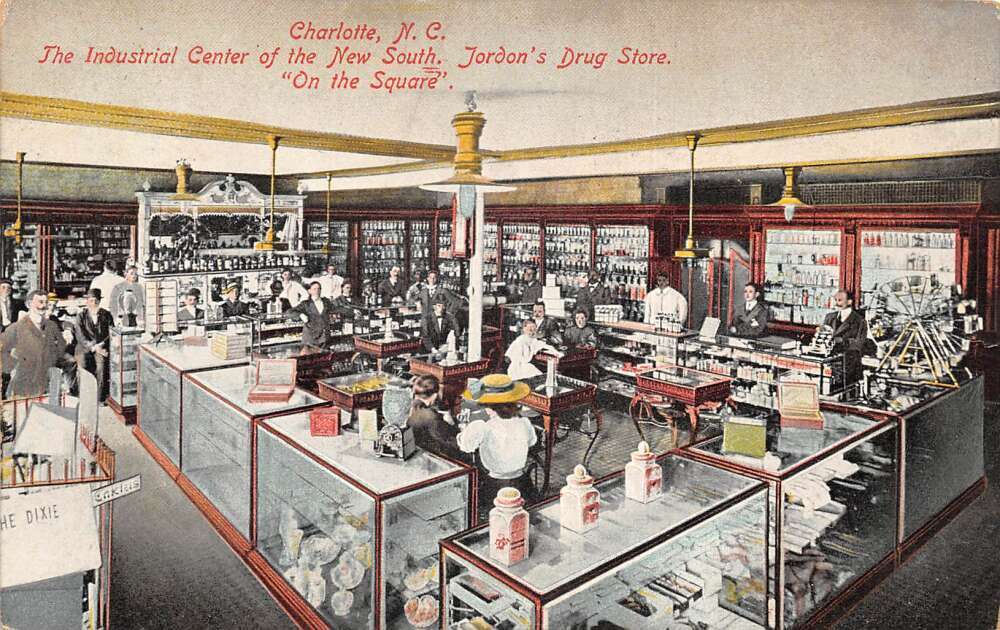
Flip over almost any printed postcard from between 1900 and 1914—whether it depicts the Eiffel Tower, Niagara Falls, or an English seaside resort—and you’ll likely find the same marking: “Printed in Germany.”
During the Golden Age of Postcards, German printing houses produced an estimated 75-80% of the world’s printed postcards. This market dominance stemmed from several factors: the country’s technological heritage and contemporary innovation, combined with policy decisions that shaped economic conditions both at home and abroad.
Technological Innovation & Precedence
Around 1440, Johannes Gutenberg invented the printing press in Mainz, Germany. That invention set Germany up for centuries as a region known for its printing technology, with Alois Senfelder inventing the process of lithography in the 1790s in Bavaria. In the centuries that followed, Germany became known as a region for high quality printing craftsmanship, with some of the best artisans in the world practicing.
As postcards started to gain popularity starting in the late 1890s, Germany was well-positioned to dominate the market in postcard production. Postcard factories in Leipzig, Berlin, and Dresden had artisans that were able to use up to 16 stones or plates for a single postcard – meaning 16 colors could be used in one postcard. Other industrialized countries like the United States and the United Kingdom could not reproduce the combined artisanal skill and technology to get the same striking postcard quality.
Not only was the diversity of colors spectacular in German postcards, the quality of the dyes were also excellent due to the country’s innovation in chemistry. At the start of the 20th century, three firms (BASF, Bayer, and Hoechst) along with five smaller companies together produced 90% of the world’s dyestuffs by 1913. Many German-printed postcards in collections today still hold on to their strong coloring with minimal fading – even 100+ years later.


Compare the two park postcards above: the top (printed in Germany) is almost 20 years older than the bottom (printed in the US) – and yet, the top still shows incredible vibrant colors of a sunset and the park, whereas the bottom postcard has seen considerable fading over the years.
Economic & Policy Factors
Economic and policy-driven factors also contributed to Germany’s success as a postcard printing hub in the early 20th century. German industries worked differently than American or British ones. Instead of every company competing against each other, German firms formed cartels and trade associations that coordinated their strategies. By 1900, Germany had 275 cartels; by 1908, over 500. These groups covered most major industries, including printing.
For postcard printers, this meant they could work together on export strategies, share information about foreign markets, and avoid undercutting each other on price. When a publisher in New York or London wanted postcards, they weren’t dealing with individual German printers competing desperately for business—they were dealing with a coordinated industry offering consistent quality and competitive prices.
American firms couldn’t do this. The Sherman Antitrust Act of 1890 made such coordination illegal in the United States, which while effective at blocking monopolies forming, did force printers to compete individually rather than as a unified front.
End of German Postcard Dominance
The passage of the Payne-Aldrich Tariff in 1909 marked the beginning of the end for both the German postcard manufacturing industry, and by extension, the Golden Age of Postcards. This tariff was levied against imported goods, with the goal to boost domestic industry. In the case of postcards, the hope was that these tariffs would allow American printers to take up more of the market supply, generating more domestic revenue and creating jobs.
However, Americans started seeing the quality decrease in postcards as a direct correlation to these tariffs, as domestic printers were not up to the task. In a 1911 issue of Novelty News, a postcard producer from Wisconsin wrote “As these manufacturers apparently could not turn out as good a card as the German manufacturers, they probably believed a protective tariff would assist them to overcome the obstacle […] We got the increased tariff at their behest, and the bankruptcy of hundreds of post card manufacturers and firms followed.” He also noted that the colors in American postcards were “abominably bad.” (source)


Another striking comparison – both of these postcards were published within two years of each other, after the Payne-Aldrich tariff. The top (printed in Germany) shows fine detail and vibrant colors, whereas the bottom (printed in the US) shows less vibrant colors, detail, and more fading from age.
World War I would be the final death knell in the German global postcard manufacturing industry. Allied Powers started the Blockade of Germany in 1914 which would put a full stop to German exports to the United Kingdom, France, and the United States – postcards, of course, included. Germany never recovered their printing industry to the same scale after the war.
However, the influences of German lithographic technology still had its impacts in postcard design and manufacturing beyond the Golden Age of Postcards. Most notably – Curt Teich, German-American postcard pioneer, came from a family of printers and worked as a printer’s apprentice in Lobenstein, Germany prior to moving to the US in 1895. He would go on to popularize the “Greetings From” postcard style, and become synonymous with the bright, bold colors and designs used in the linen postcard era in the 1930s and 1940s.
Caroline is passionate about history and has been fascinated by vintage paper ephemera and postcards since her childhood as a way to connect and learn about the past. You can explore her online ephemera and postcard shop here.